Phytase Production Specification Checklist for Industrial Buyers
Compare phytase production specs for feed, aquaculture, and plant nutrition: activity, pH, heat stability, QC, COA/TDS/SDS, pilot trials, cost-in-use.
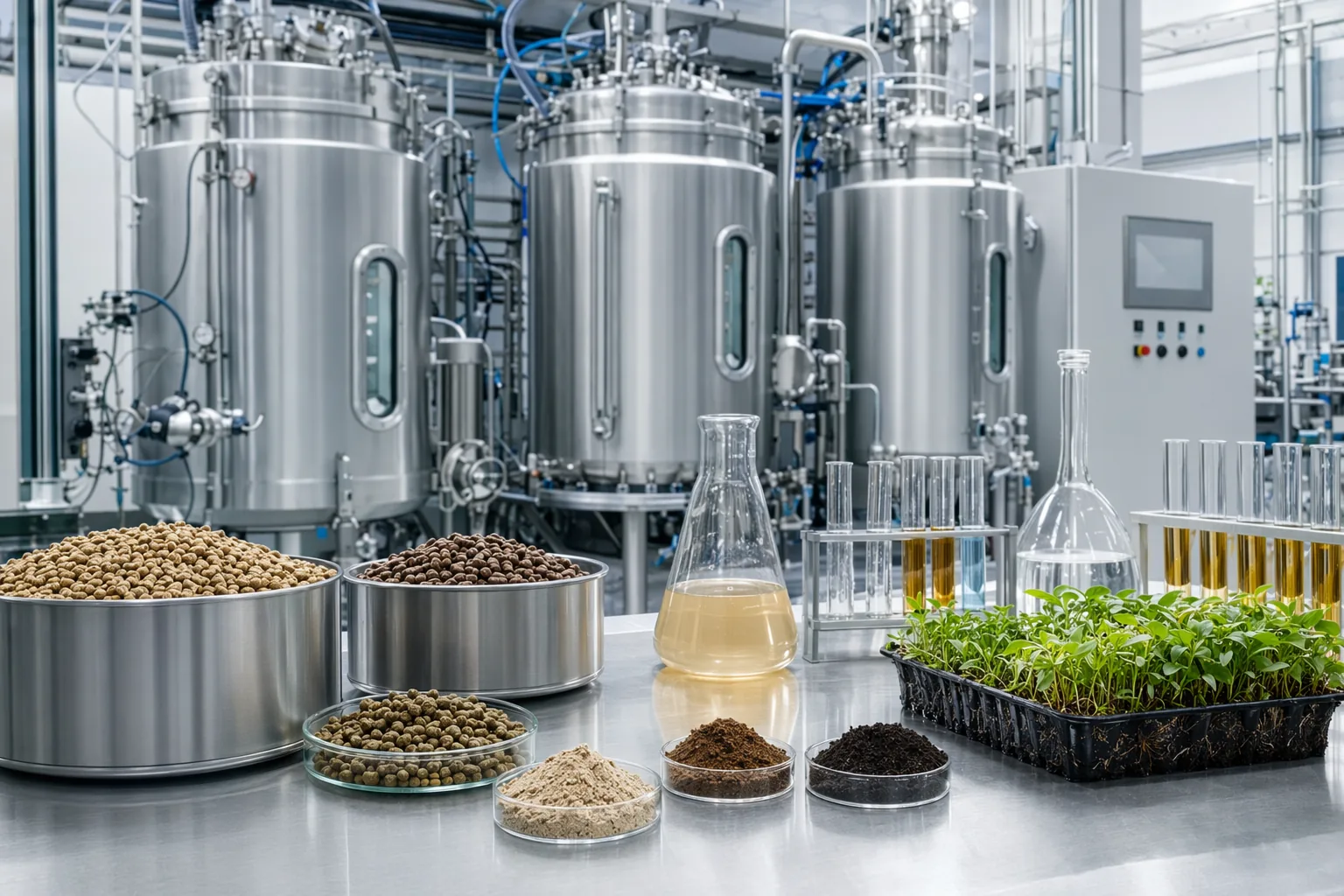
Use this practical comparison guide to evaluate phytase enzyme production quality, performance fit, documentation, and cost-in-use before sourcing for feed, aquaculture, or plant nutrition applications.
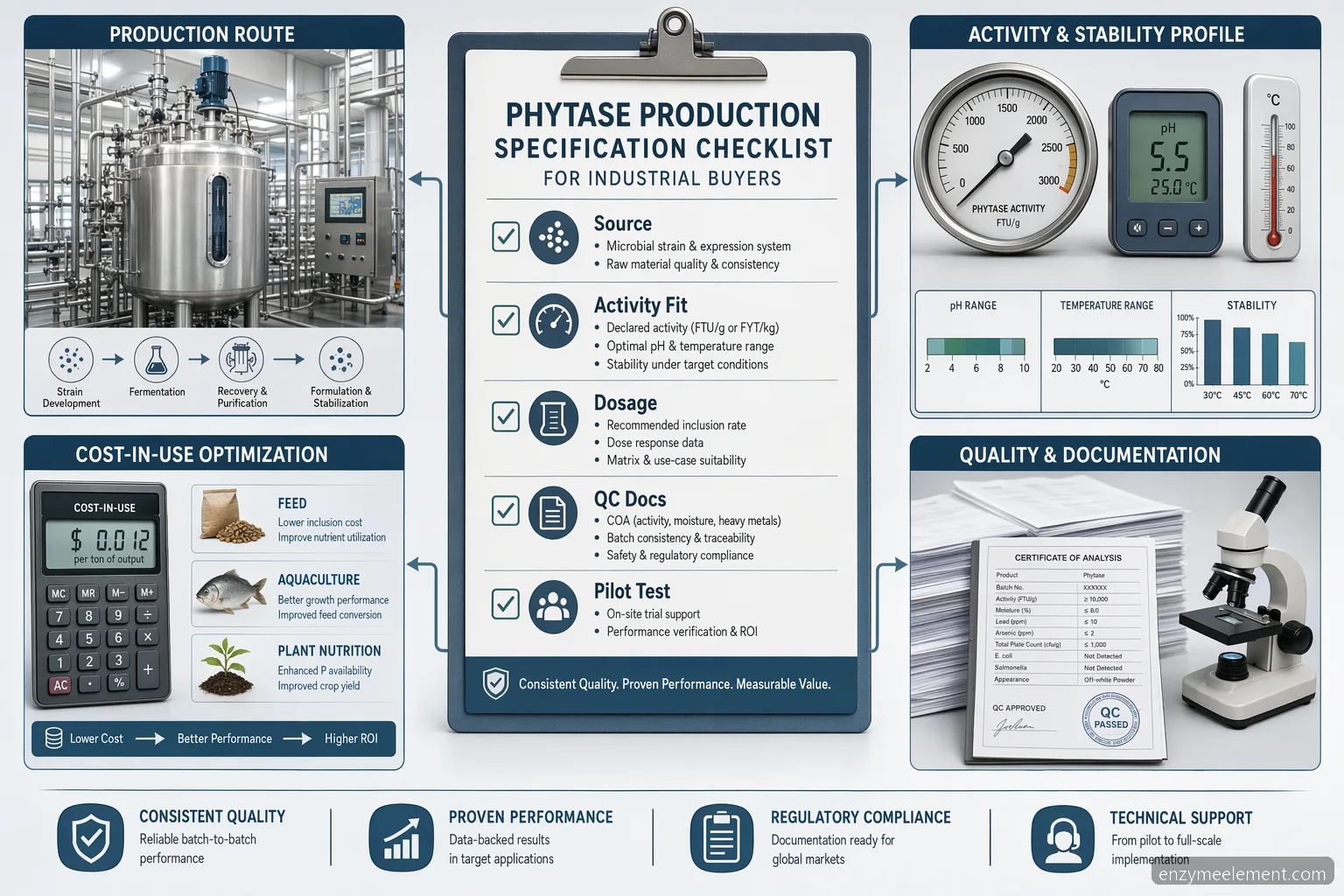
What Is Phytase in Industrial Production?
Phytase is a phosphorus release enzyme used to hydrolyze phytate, the storage form of phosphorus found in grains, oilseeds, and many plant-derived raw materials. In B2B production, buyers typically source phytase for animal feed, aquaculture diets, and selected plant nutrition systems where controlled phosphorus availability matters. Unlike consumer discussions about phytase in food or dietary supplements, industrial purchasing focuses on activity units, process tolerance, formulation handling, and regulatory suitability for the target market. The right phytase enzyme should match the substrate profile, pH exposure, residence time, and processing temperature of the application. For feed mills, that often means surviving conditioning and pelleting or being applied post-pellet. For aquaculture, stability during extrusion and performance in aquatic species diets are important. For plant nutrition, compatibility with fertilizers, carriers, water quality, and tank mixes should be confirmed before scale-up.
Primary function: release phytate-bound phosphorus. • Typical buyer focus: performance, documentation, consistency, and cost-in-use. • Common sectors: animal feed, aquaculture, and plant nutrition.
Compare Phytase Sources and Production Routes
Phytase production may use microbial fermentation with different host organisms and expression systems. Published research often discusses production and optimization of phytase from Rhizopus oligosporus, production and characterization of phytase from Lactobacillus plantarum, and fusarium phytase production. For procurement, these references are useful for understanding diversity in pH profile, thermostability, and substrate specificity, but commercial selection should be based on supplier-verified specifications and application data. A feed-grade phytase enzyme production route should be assessed for fermentation control, downstream concentration, drying or liquid stabilization, and contaminant monitoring. Buyers should ask whether the product is a liquid, powder, coated granule, or thermostable form, because formulation can influence handling and recovery after pelleting. Avoid assuming that a source organism alone determines performance. The same nominal enzyme activity can behave differently depending on formulation, assay method, carrier, coating, storage, and feed matrix.
Compare organism, expression system, and formulation separately. • Ask for the assay basis used to define phytase units. • Confirm batch traceability and change-control practices.
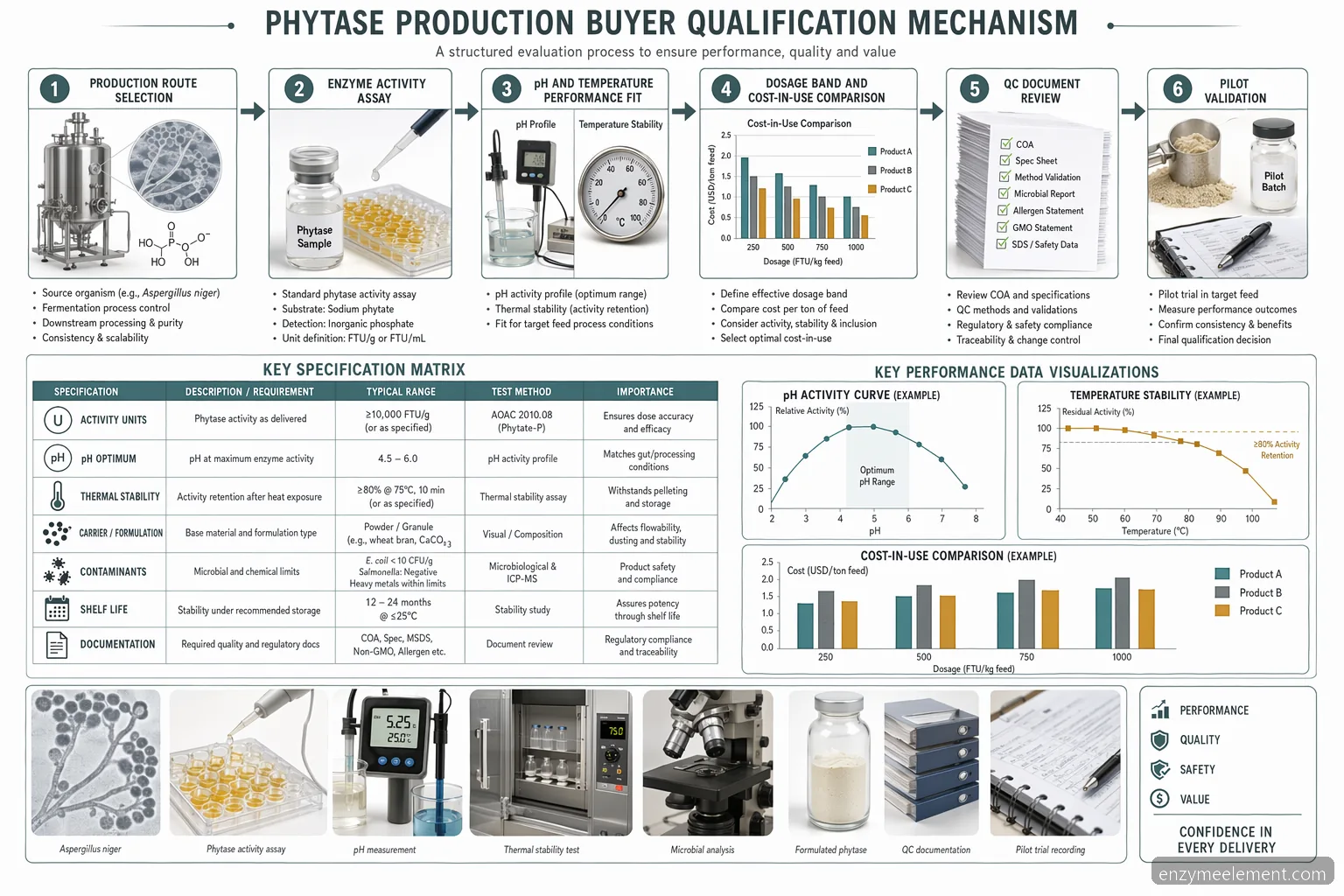
Activity, pH, and Temperature Fit
A specification checklist for phytase production should start with activity and operating window. Confirm the declared activity, such as FTU or another clearly defined phytase unit, and request the analytical method used. Many feed applications require activity under acidic digestive conditions, so performance across approximately pH 2.5 to 6.0 is often more relevant than activity at a single laboratory pH. Temperature exposure is equally important. Mash feed may be less demanding, while pelleting can expose enzyme to roughly 70 to 90°C for short periods, and extrusion can create higher thermal stress. A coated or intrinsically thermostable phytase may be appropriate when in-process recovery is critical. For liquid post-pellet application, droplet distribution, spray calibration, and mixer residence time should be included in validation. For plant nutrition, evaluate performance around the intended soil, rhizosphere, or solution pH rather than relying only on feed data.
Check activity units and assay conditions. • Evaluate pH performance across the target process range. • Measure recovery after actual heat exposure, not only lab heating. • Match liquid or dry form to dosing equipment.
Dosage Bands and Cost-in-Use Comparison
Phytase animal feed inclusion rates are usually modeled by activity delivered per kilogram or tonne of finished feed, not by product weight alone. Depending on activity concentration, matrix values, and feed formulation goals, commercial dosage may be set to support standard phosphorus release or higher replacement strategies. A practical pilot may compare several bands, such as a baseline dose, a mid-level dose, and an aggressive matrix dose, while tracking available phosphorus, calcium balance, performance indicators, and mineral premix adjustments. In aquaculture, dosage should account for species, water stability, extrusion loss, and ingredient phytate level. In plant nutrition, application rate must be verified against carrier load, dilution water, pH, and tank-mix compatibility. Cost-in-use should combine enzyme price, recovery after processing, delivered activity, storage loss, mineral savings, application cost, and risk of underdosing. The lowest price per kilogram is often not the lowest cost per unit of released phosphorus.
Calculate delivered activity after processing losses. • Include mineral replacement assumptions in the cost model. • Run side-by-side pilots before contract volume commitments.
QC Documents to Request Before Sampling
Before approving a sample, request a current COA, TDS, and SDS for the exact phytase grade under review. The COA should identify batch number, manufacture or release date, declared activity, assay method, appearance, moisture or solids where applicable, microbiological limits when relevant, and storage conditions. The TDS should describe recommended applications, pH and temperature guidance, compatibility notes, shelf life, packaging, and handling recommendations. The SDS should support safe storage, transport, spill response, and worker protection. For industrial phytase enzyme production, buyers should also ask for retained-sample policy, batch release criteria, stability data, and analytical variance. If the supplier offers both feed-grade and other grades, confirm the intended use and documentation alignment. Do not rely on generic brochures when qualifying a production lot; the documents must correspond to the product, activity, formulation, and packaging that will be purchased.
COA: batch-specific quality confirmation. • TDS: application and handling guidance. • SDS: safety and transport information. • Stability data: expected activity retention over shelf life.
Pilot Validation and Supplier Qualification
A well-designed pilot turns a phytase comparison into a purchasing decision. Start with representative raw materials, normal mill or plant conditions, and the intended inclusion equipment. Measure initial activity, post-mixing distribution, activity after pelleting or extrusion, and retained activity after storage under realistic temperature and humidity. In feed trials, confirm mineral matrix assumptions with nutrition and formulation teams. In aquaculture, include pellet water stability and species-specific diet conditions. In plant nutrition, validate compatibility with fertilizer salts, chelates, humic materials, microbial products, and tank-mix pH. Supplier qualification should review production capacity, lead time, packaging integrity, lot traceability, technical support, complaint handling, and notification of formulation or process changes. A good phytase supplier should help interpret pilot results without overstating outcomes. Final approval should be based on performance, documentation, service reliability, and total cost-in-use.
Validate on actual equipment and real formulations. • Track activity from receipt through finished product storage. • Require change-control communication for commercial supply. • Compare service capability as well as enzyme performance.
Technical Buying Checklist
Buyer Questions
Phytase is used to release phosphorus bound in phytate from plant-based feed ingredients such as corn, wheat, soybean meal, and oilseed meals. In production, the goal is to improve phosphorus availability and support formulation efficiency. Buyers should validate the selected phytase enzyme against the feed matrix, pelleting or extrusion conditions, dosage target, and mineral replacement assumptions before commercial adoption.
Compare suppliers by activity definition, pH profile, thermal recovery, formulation consistency, stability data, and batch-specific documentation. A strong phytase enzyme production offer should include COA, TDS, SDS, assay method, shelf-life guidance, and pilot support. Also review supplier capacity, traceability, change-control communication, and technical response time, because consistent commercial supply matters as much as initial sample performance.
The term phytase in food can refer to natural enzyme activity in foods, food processing research, or consumer supplement discussions. Industrial feed-grade phytase is evaluated under different purchasing requirements, including application fit, activity units, safety documentation, and regulatory suitability for the intended market. Buyers should not substitute grades without confirming specifications, documentation, permitted use, and supplier guidance for the exact application.
Key pilot tests include incoming activity confirmation, mixing uniformity, recovery after pelleting or extrusion, storage stability in the finished product, and performance under the intended dosage matrix. For aquaculture, add water stability and extrusion impact. For plant nutrition, test pH, fertilizer compatibility, and tank-mix behavior. Use results to calculate delivered activity and cost-in-use before contract purchasing.
Phytase releases phosphorus by acting on phytate, and enzyme activity depends strongly on pH. Feed applications often require useful activity in acidic digestive conditions, while plant nutrition may involve soil, rhizosphere, or solution pH. A product with high activity at one laboratory pH may not perform equally in the target process. Request a pH activity profile and validate it in the intended matrix.
Related Search Themes
phytase, phytase in food, what is phytase, phytase enzyme production, phytase enzyme, production and optimization of phytase from rhizopus oligosporus
Phytase for Research & Industry
Need Phytase for your lab or production process?
ISO 9001 certified · Food-grade & research-grade · Ships to 80+ countries
Frequently Asked Questions
What is phytase used for in animal feed production?
Phytase is used to release phosphorus bound in phytate from plant-based feed ingredients such as corn, wheat, soybean meal, and oilseed meals. In production, the goal is to improve phosphorus availability and support formulation efficiency. Buyers should validate the selected phytase enzyme against the feed matrix, pelleting or extrusion conditions, dosage target, and mineral replacement assumptions before commercial adoption.
How should buyers compare phytase enzyme production quality?
Compare suppliers by activity definition, pH profile, thermal recovery, formulation consistency, stability data, and batch-specific documentation. A strong phytase enzyme production offer should include COA, TDS, SDS, assay method, shelf-life guidance, and pilot support. Also review supplier capacity, traceability, change-control communication, and technical response time, because consistent commercial supply matters as much as initial sample performance.
Is phytase in food the same as feed-grade phytase?
The term phytase in food can refer to natural enzyme activity in foods, food processing research, or consumer supplement discussions. Industrial feed-grade phytase is evaluated under different purchasing requirements, including application fit, activity units, safety documentation, and regulatory suitability for the intended market. Buyers should not substitute grades without confirming specifications, documentation, permitted use, and supplier guidance for the exact application.
What pilot tests are most important before buying phytase?
Key pilot tests include incoming activity confirmation, mixing uniformity, recovery after pelleting or extrusion, storage stability in the finished product, and performance under the intended dosage matrix. For aquaculture, add water stability and extrusion impact. For plant nutrition, test pH, fertilizer compatibility, and tank-mix behavior. Use results to calculate delivered activity and cost-in-use before contract purchasing.
Why does pH matter when selecting a phosphorus release enzyme?
Phytase releases phosphorus by acting on phytate, and enzyme activity depends strongly on pH. Feed applications often require useful activity in acidic digestive conditions, while plant nutrition may involve soil, rhizosphere, or solution pH. A product with high activity at one laboratory pH may not perform equally in the target process. Request a pH activity profile and validate it in the intended matrix.
Related: Phytase Feed Activity & Assay
Turn This Guide Into a Supplier Brief Request a phytase specification review, pilot sample plan, and cost-in-use comparison for your production line. See our application page for Phytase Feed Activity & Assay at /applications/phytase-feed-activity-assay/ for specs, MOQ, and a free 50 g sample.
Contact Us to Contribute