Phytase In Animal Feed: Process Guide
Technical guide to phytase in animal feed: dosage, pelleting, QC, supplier qualification, COA/TDS/SDS, pilot validation, and cost-in-use.
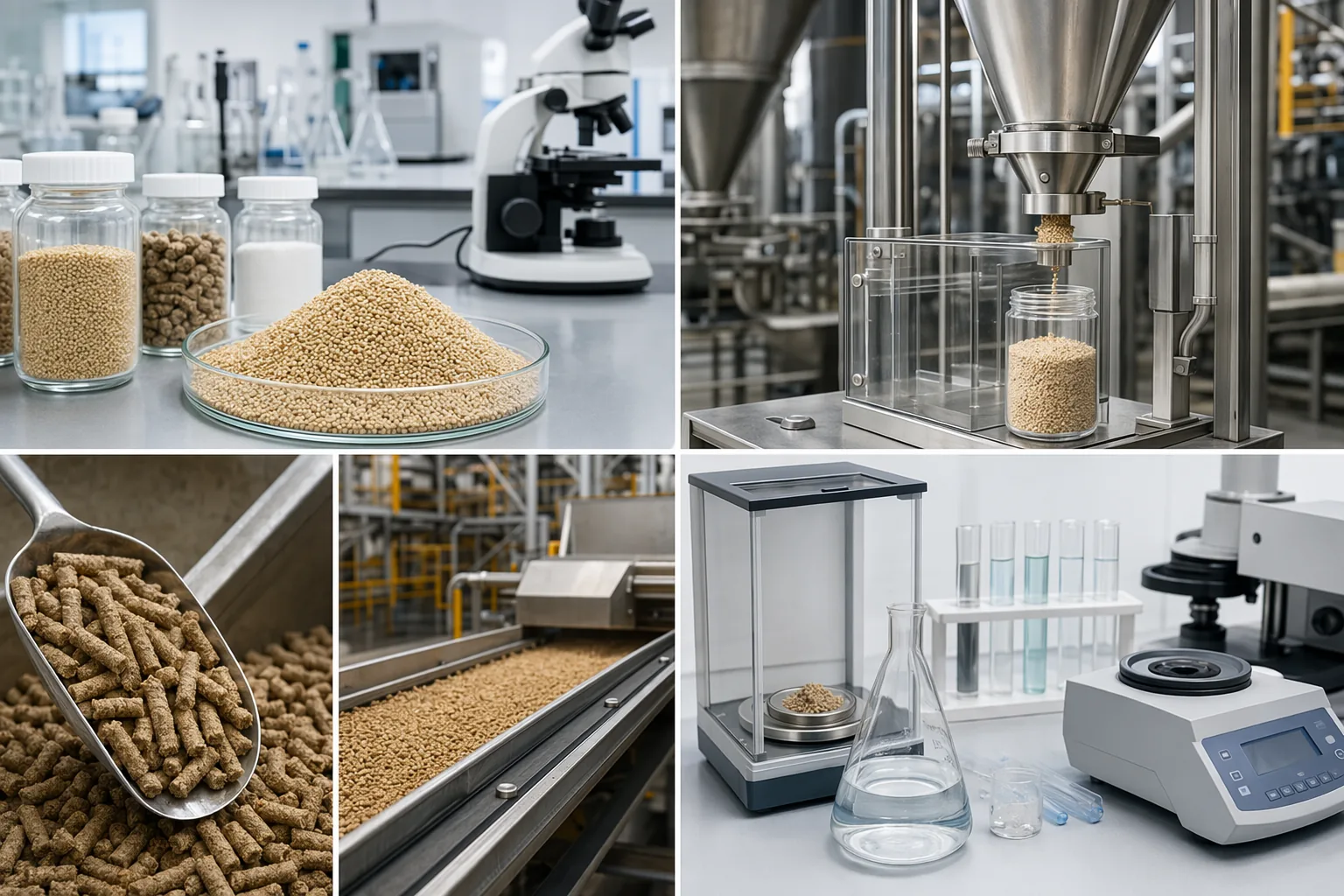
Phytase helps feed manufacturers release phytate-bound phosphorus, improve mineral availability, and optimize formulation cost when validated under real processing conditions.
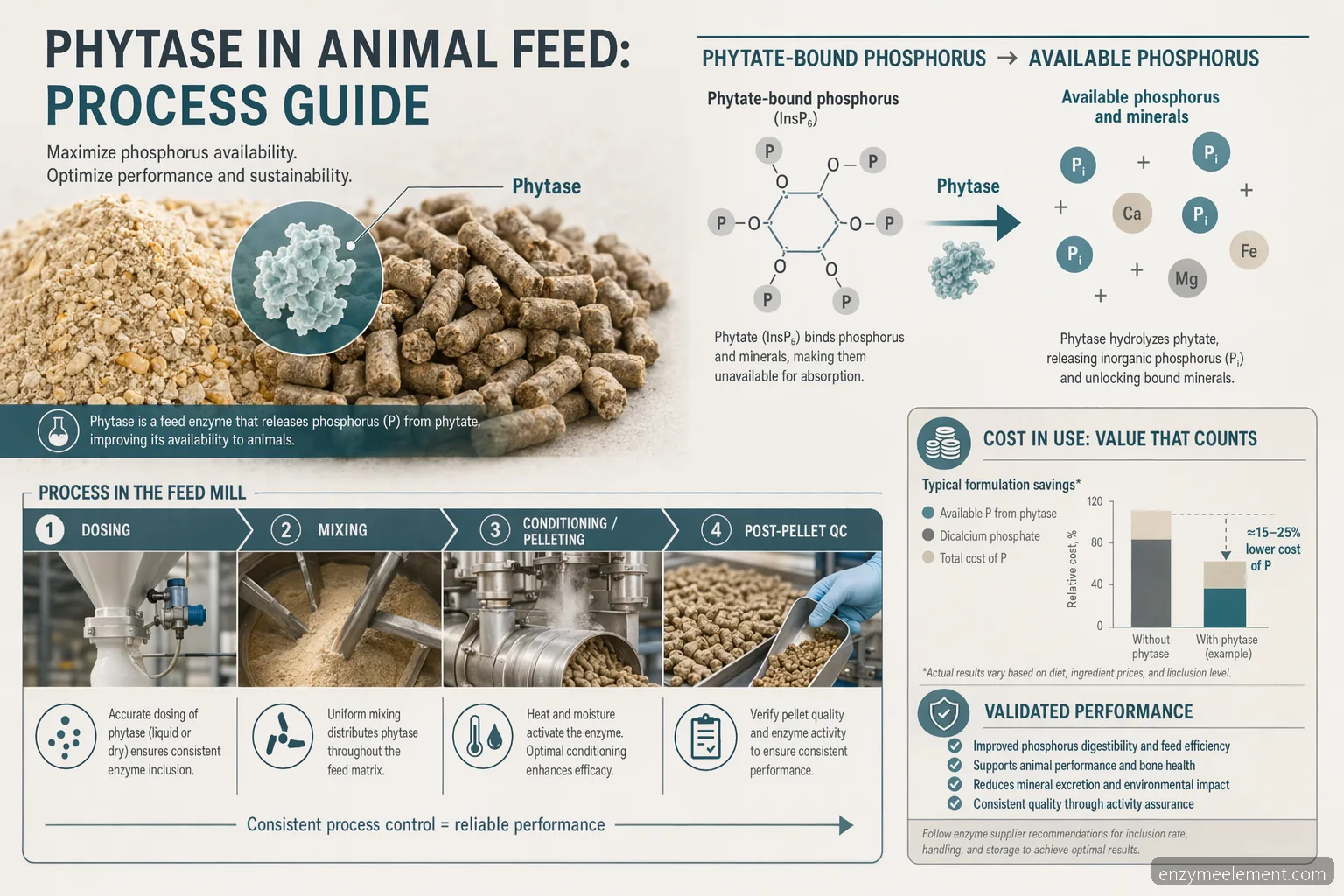
Why phytase is used in animal feed
Phytase is a phosphorus release enzyme used in poultry, swine, aquaculture, and other compound feed systems. Plant ingredients such as corn, wheat, soybean meal, rice bran, and oilseed meals contain phosphorus largely bound as phytate, which monogastric animals utilize poorly without enzymatic hydrolysis. Adding phytase enzyme for animal feed can release a portion of this bound phosphorus during digestion, allowing nutritionists to adjust inorganic phosphate, calcium, and trace mineral assumptions. The value is not only nutritional; it is also operational, because enzyme performance must survive premix handling, mixing, conditioning, pelleting, transport, and storage. For industrial buyers, the decision should be based on verified activity, feed matrix design, and process recovery rather than headline activity alone. Enzyme Element supports phytase animal feed evaluations with product data review, sample coordination, and application-focused validation planning.
Primary function: hydrolyze phytate and release phosphorus • Common users: feed mills, integrators, premix producers, and aquafeed manufacturers • Typical targets: mineral nutrition, formulation efficiency, and phosphorus management
Key process conditions for reliable phytase performance
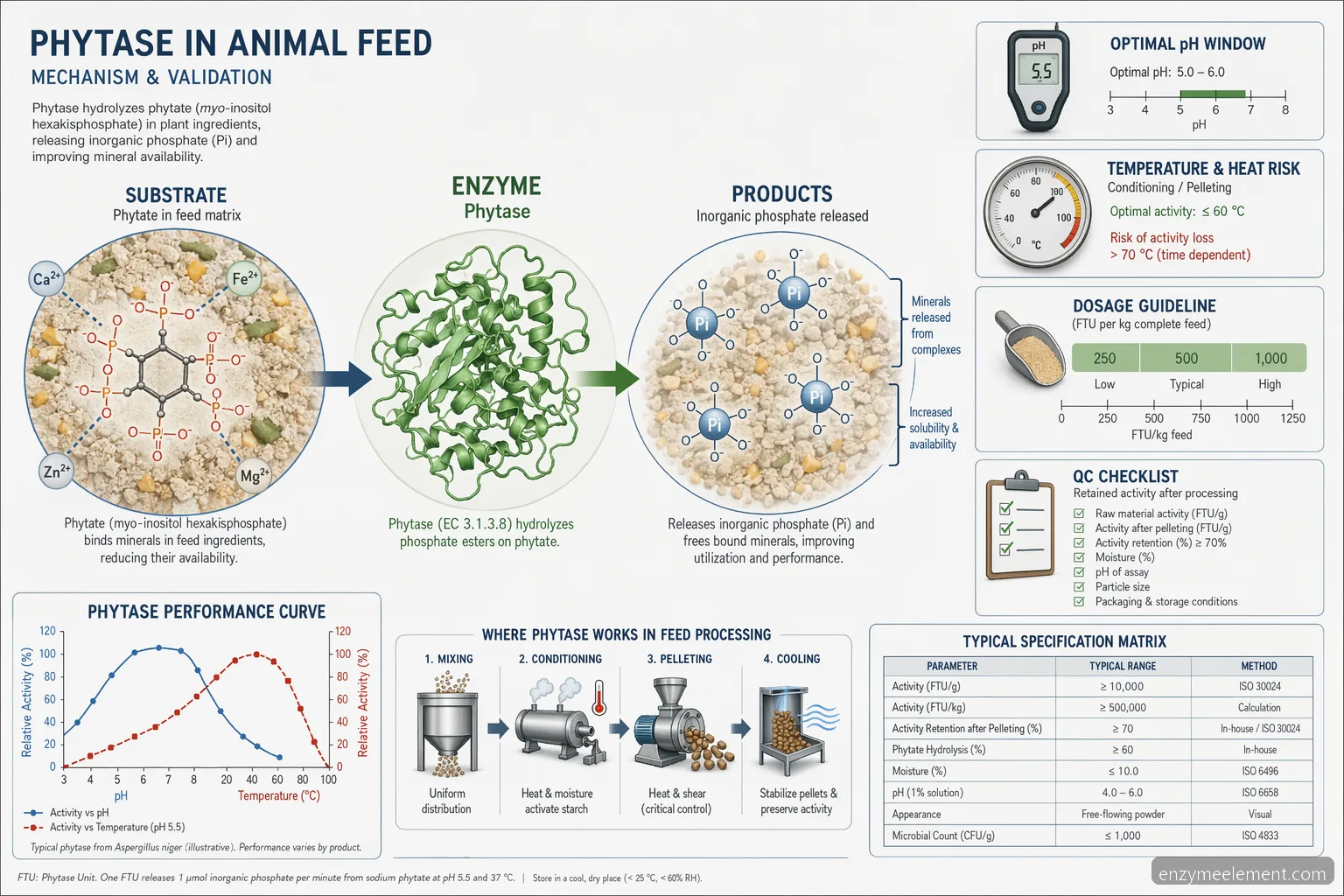
Phytase performance depends on matching the enzyme to the animal, diet, and feed manufacturing process. Many commercial phytase products show useful activity in acidic digestive conditions, commonly around pH 2.5–5.5, though the exact profile must be confirmed on the supplier TDS. Conditioning and pelleting can reduce activity if temperature, moisture, steam quality, or residence time are aggressive. Standard pelleting often exposes feed to about 70–90°C, while more severe hygienization steps can be higher; therefore, coated or thermostable grades may be required. Liquid post-pellet application can reduce heat exposure but requires accurate spraying, mixer design, and uniform coating. Buyers should evaluate retained FTU activity after the actual process, not just laboratory activity before pelleting. The most reliable selection process includes pilot batches, retained-activity testing, and performance comparison against the intended feed formula.
Check supplier-declared pH activity profile • Measure activity before and after pelleting • Validate liquid application uniformity if using post-pellet dosing • Assess storage stability under local humidity and temperature
Dosage bands and formulation approach
A practical dosage band for phytase for animal feed is often 250–2,000 FTU/kg complete feed, with common commercial use frequently centered around 500–1,500 FTU/kg depending on species, feed phase, ingredient phytate level, and expected matrix value. Higher inclusion may be considered in some high-phytate diets or where nutritionists target greater phosphorus release, but it should be supported by response data. Dosage should not be copied directly from another mill because particle size, premix dilution, pelleting severity, storage time, and mineral balance can change the delivered activity. Formulators should consider available phosphorus, calcium-to-phosphorus ratio, sodium, trace minerals, and antagonistic effects of excessive calcium. A phytase enzyme supplier for animal feed should provide guidance on declared FTU units, recommended matrix values, and analytical methods used to confirm activity.
Typical band: 250–2,000 FTU/kg complete feed • Confirm matrix values with species and diet-specific data • Avoid over-crediting phosphorus release without retained-activity testing • Review calcium assumptions alongside phosphorus assumptions
Quality control checks for feed mill implementation
QC should begin before the first commercial order. Each phytase batch should be supplied with a COA showing enzyme activity, lot number, production date or retest date, and relevant physical specifications. The TDS should define activity units, carrier or formulation type, storage guidance, compatibility notes, and recommended handling. The SDS should support safe industrial handling and worker training. In the mill, quality teams should check receiving condition, product identity, dosing accuracy, scale calibration, premix dilution, and mixing uniformity. Finished feed should be tested for enzyme recovery when the process is new, modified, or run at higher conditioning temperatures. Homogeneity targets are often managed using coefficient of variation testing, with many feed mills aiming for CV values near or below 10% for micro-ingredients, depending on internal standards.
Verify COA against purchase specification • Confirm TDS activity unit and test method • Maintain SDS access for handling and training • Test retained activity after pelleting or extrusion • Monitor micro-ingredient mixing uniformity
Supplier qualification and purchasing criteria
Selecting a phytase supplier for animal feed should combine technical performance, documentation quality, supply reliability, and commercial transparency. Buyers should request representative samples, current COA, TDS, SDS, shelf-life statement, packaging options, storage conditions, and guidance for premix or direct-to-feed use. A qualified supplier should explain how activity is measured, how lot consistency is controlled, and what support is available for pilot validation. Avoid purchasing solely by price per kilogram because enzyme concentration, retained activity, dosage, and phosphorus matrix value determine real cost-in-use. The animal feed phytase market includes powders, granules, coated products, and liquids; each format has different handling, dust, stability, and application requirements. Supplier qualification should also consider lead time, batch traceability, change notification, complaint handling, and ability to support scale-up from trial to recurring industrial supply.
Compare cost per delivered FTU, not only price per kg • Request documentation before approval • Confirm traceability and change-control expectations • Evaluate packaging fit for mill handling systems
Pilot validation and cost-in-use modeling
Pilot validation converts a phytase quote into a defensible purchasing decision. A typical evaluation starts with a defined feed formula, target FTU/kg, process route, sampling plan, and analytical method. Samples may be taken from the enzyme container, premix, mash feed, post-pellet feed, and retained storage samples. Results should show whether the selected phytase enzyme supplier for animal feed can deliver the intended activity through the real production process. Cost-in-use should include enzyme dosage, phosphorus source reduction, any calcium or mineral adjustments, application equipment, inventory handling, testing, and expected process losses. For aquaculture or extruded feeds, validation is especially important because moisture, shear, and heat exposure can differ from standard poultry or swine pelleting. A clear pilot protocol helps procurement, nutrition, QA, and production teams approve the same commercial specification.
Define success criteria before the trial • Sample before and after heat processing • Calculate cost per tonne of finished feed • Include testing and handling costs in the model
Technical Buying Checklist
Buyer Questions
Phytase hydrolyzes phytate, the main storage form of phosphorus in many plant feed ingredients. This can release phosphorus that monogastric animals would otherwise use inefficiently. In commercial feed formulation, phytase may allow partial replacement of inorganic phosphate and adjustment of mineral assumptions. The actual value depends on enzyme activity, diet composition, species, dosage, and retained activity after feed processing.
A common industrial dosage range is about 250–2,000 FTU/kg complete feed, with many programs using 500–1,500 FTU/kg depending on objectives. The correct dose should be set by a nutritionist using the supplier’s TDS, species data, feed formula, phytate level, pelleting recovery, and phosphorus matrix value. Pilot testing is recommended before broad commercial adoption.
Some phytase products can retain useful activity through pelleting, but survival depends on enzyme design, coating, conditioning temperature, moisture, steam quality, residence time, and die conditions. Feed commonly encounters about 70–90°C during pelleting, and harsher processes may reduce activity more. Buyers should test retained FTU activity after their actual process rather than relying only on supplier activity before heat treatment.
A qualified phytase enzyme supplier for animal feed should provide a batch COA, technical data sheet, safety data sheet, shelf-life or retest guidance, storage instructions, packaging details, and recommended application information. The COA should identify the lot and declared activity. The TDS should define activity units, dosage guidance, pH and temperature considerations, and any formulation or handling limitations.
Phytase in animal feed is purchased and validated for feed processing, animal nutrition, and phosphorus release in formulated diets. Phytase in food or food processing may involve different regulatory status, purity expectations, processing aims, and customer requirements. Industrial buyers should specify the intended application clearly and avoid using a feed-grade product in food applications unless it is explicitly qualified for that use.
Compare quotations by delivered value, not only price per kilogram. Key variables include declared FTU activity, recommended dosage, retained activity after pelleting or extrusion, expected phosphorus matrix value, packaging efficiency, shelf life, testing needs, and supplier support. A lower unit price may be less economical if higher dosage or larger process losses increase the true cost per tonne of finished feed.
Phytase for Research & Industry
Need Phytase for your lab or production process?
ISO 9001 certified · Food-grade & research-grade · Ships to 80+ countries
Frequently Asked Questions
What does phytase do in animal feed?
Phytase hydrolyzes phytate, the main storage form of phosphorus in many plant feed ingredients. This can release phosphorus that monogastric animals would otherwise use inefficiently. In commercial feed formulation, phytase may allow partial replacement of inorganic phosphate and adjustment of mineral assumptions. The actual value depends on enzyme activity, diet composition, species, dosage, and retained activity after feed processing.
What is a typical phytase dosage in complete feed?
A common industrial dosage range is about 250–2,000 FTU/kg complete feed, with many programs using 500–1,500 FTU/kg depending on objectives. The correct dose should be set by a nutritionist using the supplier’s TDS, species data, feed formula, phytate level, pelleting recovery, and phosphorus matrix value. Pilot testing is recommended before broad commercial adoption.
Can phytase survive pelleting?
Some phytase products can retain useful activity through pelleting, but survival depends on enzyme design, coating, conditioning temperature, moisture, steam quality, residence time, and die conditions. Feed commonly encounters about 70–90°C during pelleting, and harsher processes may reduce activity more. Buyers should test retained FTU activity after their actual process rather than relying only on supplier activity before heat treatment.
What documents should a phytase supplier provide?
A qualified phytase enzyme supplier for animal feed should provide a batch COA, technical data sheet, safety data sheet, shelf-life or retest guidance, storage instructions, packaging details, and recommended application information. The COA should identify the lot and declared activity. The TDS should define activity units, dosage guidance, pH and temperature considerations, and any formulation or handling limitations.
How is phytase different from phytase in food applications?
Phytase in animal feed is purchased and validated for feed processing, animal nutrition, and phosphorus release in formulated diets. Phytase in food or food processing may involve different regulatory status, purity expectations, processing aims, and customer requirements. Industrial buyers should specify the intended application clearly and avoid using a feed-grade product in food applications unless it is explicitly qualified for that use.
How should buyers compare phytase quotations?
Compare quotations by delivered value, not only price per kilogram. Key variables include declared FTU activity, recommended dosage, retained activity after pelleting or extrusion, expected phosphorus matrix value, packaging efficiency, shelf life, testing needs, and supplier support. A lower unit price may be less economical if higher dosage or larger process losses increase the true cost per tonne of finished feed.
Related: Phytase Feed Activity & Assay
Turn This Guide Into a Supplier Brief Request phytase samples, COA/TDS/SDS review, and pilot validation support for your animal feed process. See our application page for Phytase Feed Activity & Assay at /applications/phytase-feed-activity-assay/ for specs, MOQ, and a free 50 g sample.
Contact Us to Contribute