Phytase in Poultry Feed: Dosage, pH, Temperature, and Feed Mill Control
Troubleshoot phytase in poultry feed: dosage, pH fit, pelleting temperature, QC checks, COA/TDS/SDS, pilot validation, and cost-in-use.
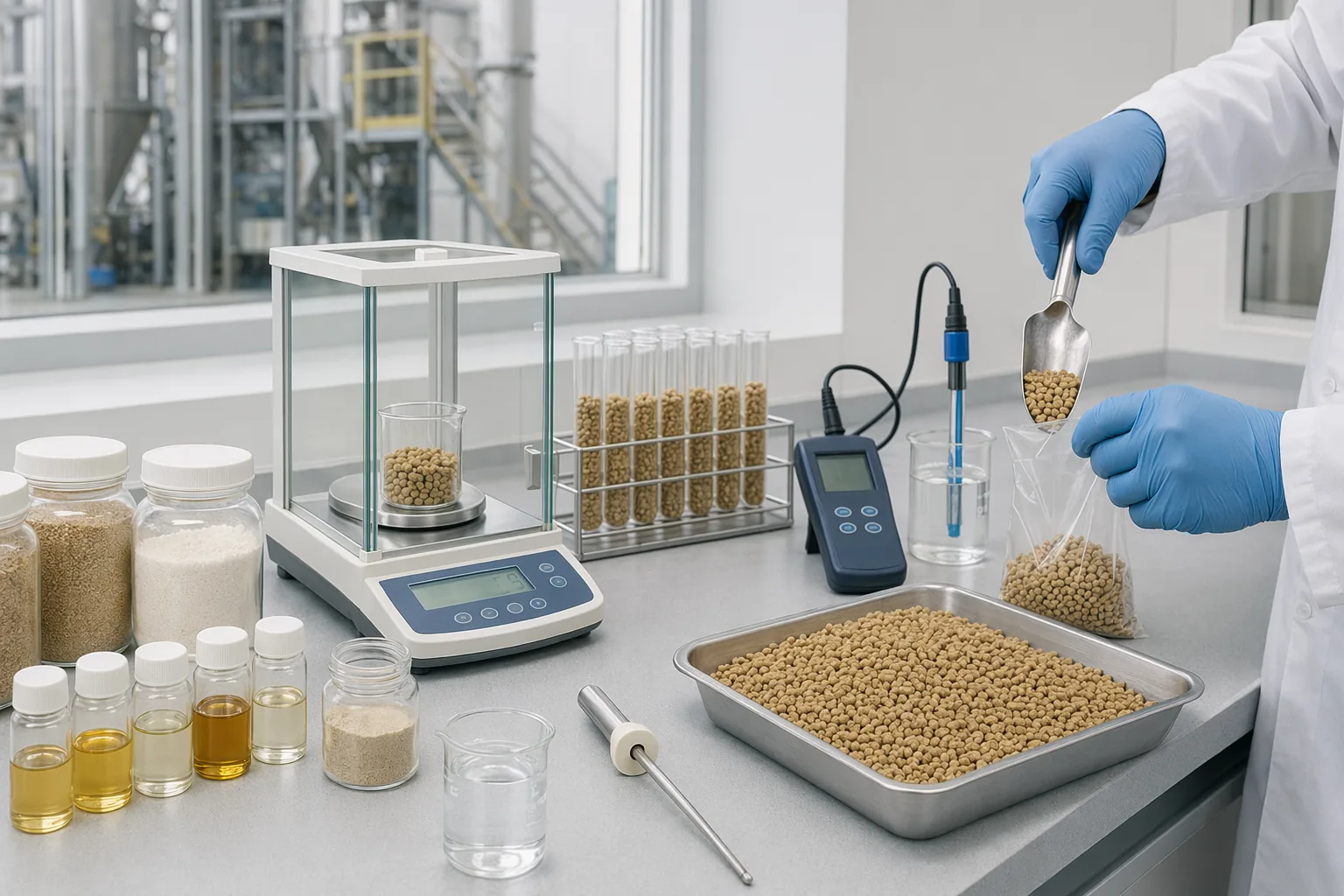
A practical B2B guide for feed manufacturers and integrators troubleshooting phytase performance, phosphorus release, pelleting losses, and supplier qualification.
What Is Phytase and Why It Matters in Poultry Feed
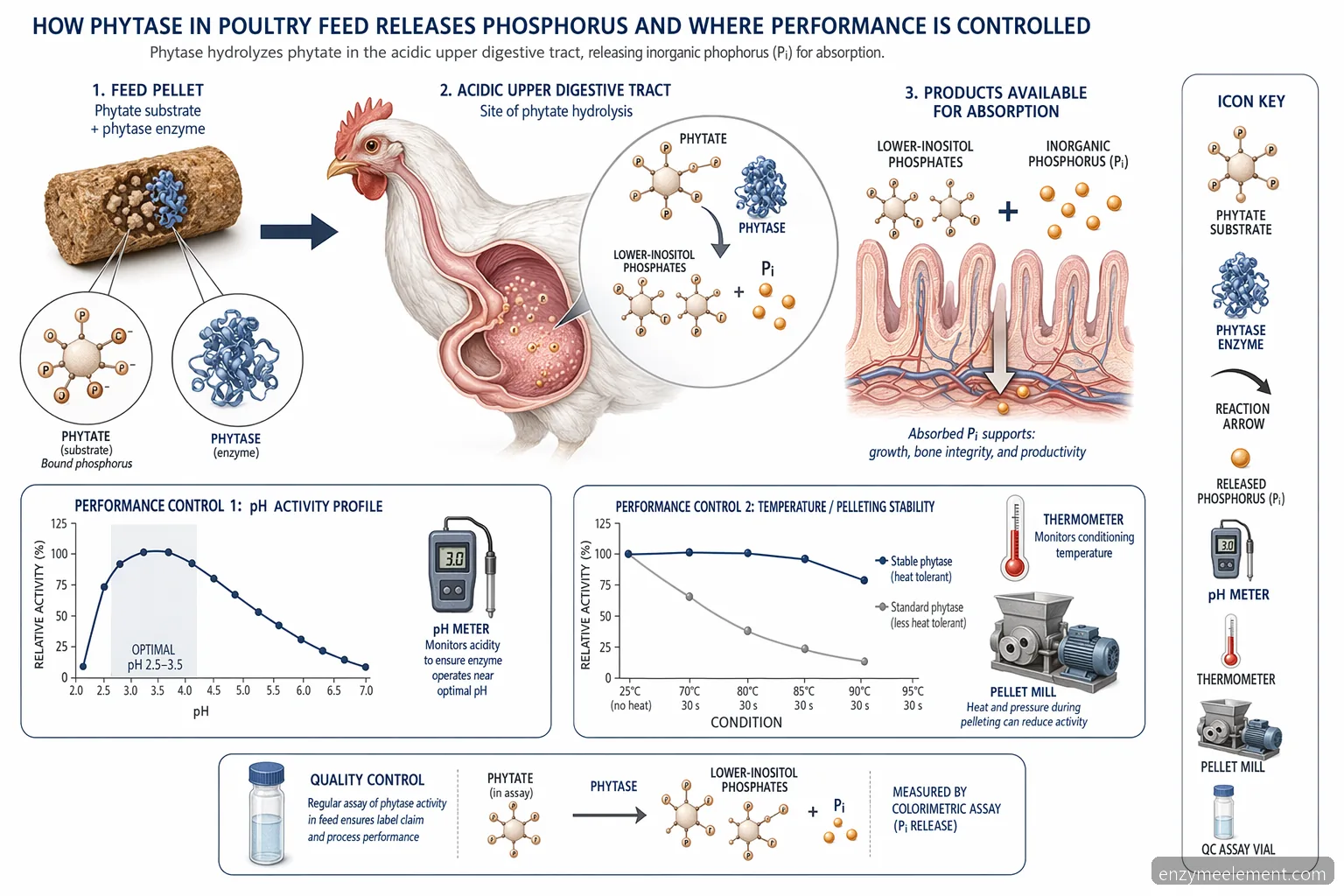
For feed formulators asking what is phytase, it is a phosphorus release enzyme used to hydrolyze phytate, the main storage form of phosphorus in many plant-based feed ingredients. In poultry diets, phytate can bind phosphorus, calcium, trace minerals, amino acids, and energy, reducing nutrient availability. Phytase in poultry feed is therefore used to improve phosphorus utilization and reduce reliance on inorganic phosphate sources, while supporting more efficient diet formulation. This page focuses on B2B animal feed use, not medical supplement advice or consumer phytase in food applications. The commercial decision is not simply which product has the highest label activity. Buyers should compare activity method, pH curve, heat tolerance, matrix recommendation, compatibility with premix handling, and retained activity in their own feed mill. A phytase feed additive must work inside the bird and survive the process that delivers it.
Primary value: release phytate-bound phosphorus • Secondary formulation value: mineral and nutrient matrix contribution • Key risk: loss of activity during pelleting or storage
Dosage Bands: From Standard Inclusion to Superdosing
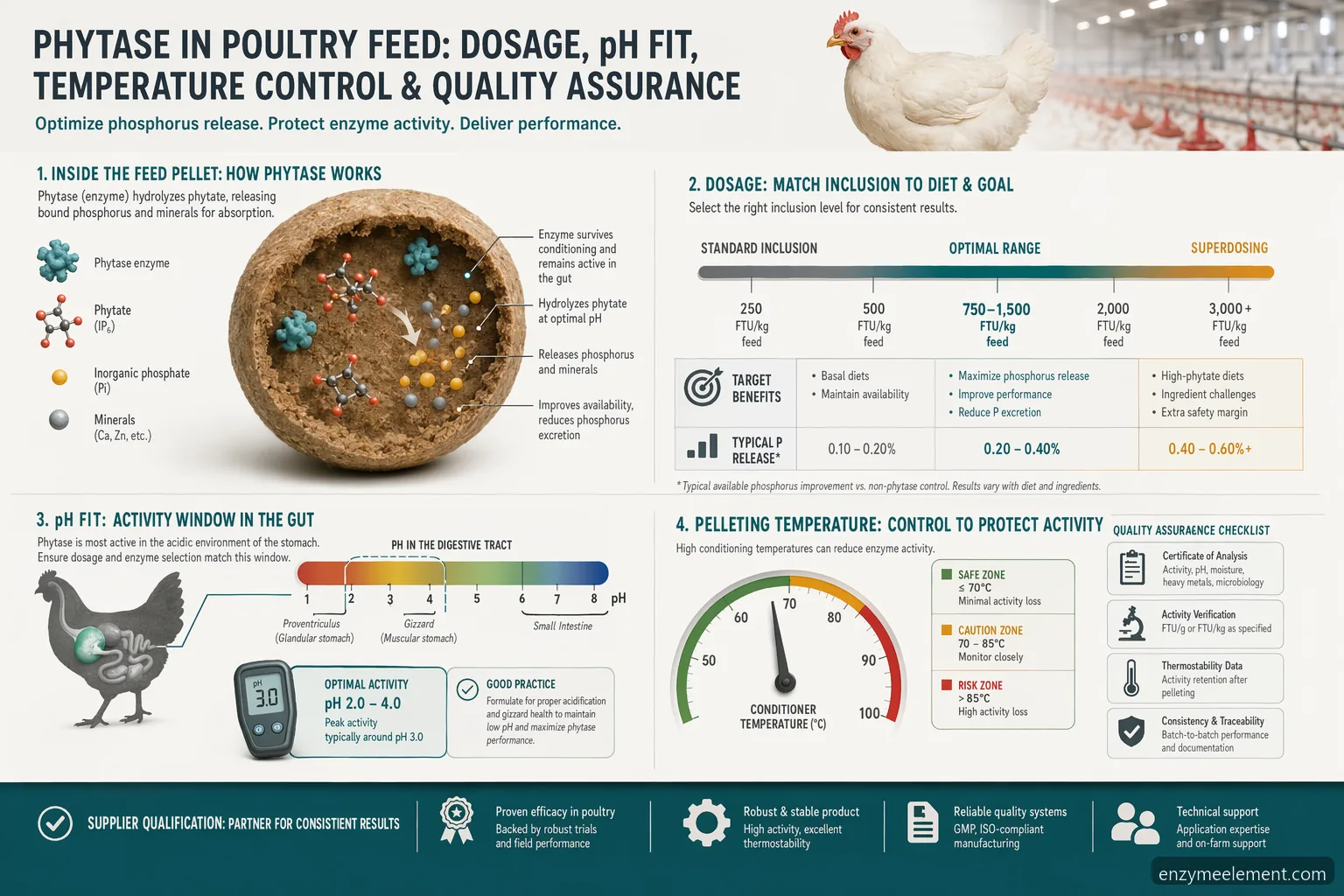
Typical phytase poultry feed programs begin around 500 FTU/kg finished feed, although the correct level depends on diet composition, target matrix release, bird age, phosphate pricing, and the enzyme supplier’s validated recommendation. Many broiler, layer, and breeder diets are evaluated in the 500 to 1,500 FTU/kg range. Some programs use 1,500 to 3,000 FTU/kg or more as a superdosing strategy, but this should be supported by trial data, formulation safeguards, and economic review. Under-dosing can result from incorrect premix dilution, poor mixing uniformity, heat damage, or inaccurate liquid application. Over-reliance on a matrix value without feed-mill verification can also create performance risk. The best phytase enzyme for poultry feed is the one that consistently delivers retained activity and validated nutrient release at the lowest practical cost-in-use, not necessarily the one with the lowest price per kilogram.
Starting evaluation: 500 FTU/kg finished feed • Common commercial range: 500 to 1,500 FTU/kg • Superdosing: validate before assigning aggressive matrix values • Confirm mixer CV and actual enzyme recovery
pH Fit: Match Enzyme Activity to the Bird and Diet
Phytase enzyme performance depends strongly on pH. Many commercial phytase products are designed to work in acidic digestive conditions, with useful activity often reported across approximately pH 2.5 to 5.5, depending on enzyme type and assay method. This matters because phytate hydrolysis should begin early in the upper digestive tract before mineral complexes move further through the bird. When troubleshooting phytase in animal feed, review the supplier’s activity curve rather than relying on a single label value. Diet buffering capacity, calcium level, limestone particle size, and acid-binding ingredients may influence how quickly the gastrointestinal environment reaches an effective pH. If a product has a narrow pH activity window, results may vary more across formulations. A robust supplier should provide technical data showing activity across relevant pH conditions and explain how those data relate to poultry feed applications.
Review activity from about pH 2.5 to 5.5 • Check assay conditions used on the TDS • Avoid assuming all phytase enzymes share the same pH profile • Consider calcium and buffering effects in formulation
Temperature and Pelleting: Where Activity Is Often Lost
Heat exposure is one of the most common causes of weak phytase results in pelleted poultry feed. Conditioning temperatures commonly range from 75°C to 90°C, with residence times that may vary from 15 to 60 seconds or longer depending on mill design. Some coated or intrinsically thermostable phytase products tolerate these conditions better than standard dry enzymes, but retained activity should be measured in your process. If conditioning exceeds the supplier’s recommended range, post-pellet liquid application may be more reliable, provided spray distribution and calibration are controlled. Moisture, steam quality, die friction, fat addition point, and cooling rate can also influence enzyme survival. Do not evaluate pelleting stability only from a brochure claim. Ask for retained-activity data under comparable feed-mill conditions, then run a pilot batch and test mash, hot pellet, cooled pellet, and stored feed samples.
Common conditioning: 75°C to 90°C • Typical residence time: 15 to 60 seconds • Test retained activity after cooling • Consider post-pellet application for high-heat processes
QC Checks for Reliable Phytase Feed Additive Performance
A reliable phytase feed additive program needs routine quality control from receiving through finished feed release. Incoming material should be checked against the COA for lot number, declared activity, manufacturing date, shelf life, carrier, appearance, and storage requirements. The TDS should define activity units, recommended dosage, pH profile, thermal guidance, and compatibility limits. The SDS should be reviewed for safe handling, dust exposure, personal protective equipment, and spill procedures. In production, verify weighing accuracy, premix dilution, mixer sequence, and liquid pump calibration if applicable. Finished feed testing should include enzyme recovery, moisture, pellet durability where relevant, and retention after storage. For troubleshooting, compare expected versus measured FTU/kg at each stage. A structured sampling plan is essential because enzyme distribution errors can be mistaken for product failure.
Check COA against purchase specification • Review TDS for units, dosage, pH, and temperature guidance • Review SDS for handling and worker safety • Test recovery in mash and finished feed • Track retained activity during storage
Supplier Qualification and Cost-in-Use Evaluation
Industrial buyers should qualify phytase suppliers using both technical and commercial criteria. Request current COA, TDS, SDS, stability data, recommended matrix values, assay method, packaging options, storage conditions, and documentation for lot traceability. Pilot validation should include your raw materials, mixer, pelleting conditions, and target bird class, because supplier data may not fully represent your process. Cost-in-use should compare delivered enzyme cost, dosage rate, retained activity, inorganic phosphate replacement, safety margin, logistics, shelf life, and support for formulation changes. A low-cost product can become expensive if higher inclusion is needed or if activity is lost during pelleting. Conversely, a premium product may be justified if it improves recovery and reduces phosphate input consistently. The right phytase in poultry feed program is a controlled purchasing, formulation, and processing decision supported by data.
Request documentation before approval • Run pilot validation under actual mill conditions • Compare cost per retained FTU, not only cost per kilogram • Confirm supplier support for troubleshooting and formulation review
Technical Buying Checklist
Buyer Questions
Many poultry formulations start phytase evaluation around 500 FTU/kg finished feed, with common commercial programs ranging from 500 to 1,500 FTU/kg. Higher superdosing levels may be used, but they should be justified by supplier data, feed formulation objectives, and pilot validation. The right dosage depends on diet phytate level, calcium and phosphorus targets, pelleting loss, bird class, and the matrix value assigned in formulation.
Activity can drop because phytase is a protein enzyme and may be damaged by steam, heat, moisture, pressure, die friction, or long conditioner residence time. Pelleting at 75°C to 90°C is common, but enzyme survival varies by product and process. Troubleshooting should compare enzyme recovery in mash, hot pellet, cooled pellet, and stored feed. If losses are high, consider coated products or liquid post-pellet application.
Compare suppliers using documentation, retained-activity data, technical support, and cost-in-use rather than price alone. Request COA, TDS, SDS, assay method, pH profile, thermal guidance, storage requirements, lot traceability, and recommended matrix values. A qualified supplier should support pilot validation under your feed-mill conditions and help interpret recovery data, formulation impact, and any mismatch between expected and measured FTU/kg in finished feed.
Not exactly. Phytase in food may refer to food processing, fermentation, or ingredient applications, while phytase in animal feed is formulated as a feed enzyme for livestock nutrition. This page addresses industrial poultry feed manufacturing and phosphorus release, not human medical supplements or consumer nutrition claims. Buyers should evaluate phytase products according to feed regulations, process stability, technical documentation, and animal-feed performance validation.
Useful checks include incoming COA verification, lot traceability, enzyme activity testing, mixer uniformity, weighing accuracy, liquid pump calibration, and retained FTU/kg in mash and finished feed. For pelleted diets, test after conditioning, cooling, and storage when possible. Also review moisture, pellet durability, storage temperature, and sample handling. A poor result may come from processing loss, uneven distribution, sampling error, or incorrect matrix assumptions.
Phytase for Research & Industry
Need Phytase for your lab or production process?
ISO 9001 certified · Food-grade & research-grade · Ships to 80+ countries
Frequently Asked Questions
What is the usual phytase dosage in poultry feed?
Many poultry formulations start phytase evaluation around 500 FTU/kg finished feed, with common commercial programs ranging from 500 to 1,500 FTU/kg. Higher superdosing levels may be used, but they should be justified by supplier data, feed formulation objectives, and pilot validation. The right dosage depends on diet phytate level, calcium and phosphorus targets, pelleting loss, bird class, and the matrix value assigned in formulation.
Why does phytase activity drop after pelleting?
Activity can drop because phytase is a protein enzyme and may be damaged by steam, heat, moisture, pressure, die friction, or long conditioner residence time. Pelleting at 75°C to 90°C is common, but enzyme survival varies by product and process. Troubleshooting should compare enzyme recovery in mash, hot pellet, cooled pellet, and stored feed. If losses are high, consider coated products or liquid post-pellet application.
How should buyers compare phytase suppliers?
Compare suppliers using documentation, retained-activity data, technical support, and cost-in-use rather than price alone. Request COA, TDS, SDS, assay method, pH profile, thermal guidance, storage requirements, lot traceability, and recommended matrix values. A qualified supplier should support pilot validation under your feed-mill conditions and help interpret recovery data, formulation impact, and any mismatch between expected and measured FTU/kg in finished feed.
Is phytase in food the same topic as phytase in animal feed?
Not exactly. Phytase in food may refer to food processing, fermentation, or ingredient applications, while phytase in animal feed is formulated as a feed enzyme for livestock nutrition. This page addresses industrial poultry feed manufacturing and phosphorus release, not human medical supplements or consumer nutrition claims. Buyers should evaluate phytase products according to feed regulations, process stability, technical documentation, and animal-feed performance validation.
What QC tests help troubleshoot phytase in poultry feed?
Useful checks include incoming COA verification, lot traceability, enzyme activity testing, mixer uniformity, weighing accuracy, liquid pump calibration, and retained FTU/kg in mash and finished feed. For pelleted diets, test after conditioning, cooling, and storage when possible. Also review moisture, pellet durability, storage temperature, and sample handling. A poor result may come from processing loss, uneven distribution, sampling error, or incorrect matrix assumptions.
Related: Phytase Feed Activity & Assay
Turn This Guide Into a Supplier Brief Request a phytase specification review, pilot validation plan, and cost-in-use comparison for your poultry feed process. See our application page for Phytase Feed Activity & Assay at /applications/phytase-feed-activity-assay/ for specs, MOQ, and a free 50 g sample.
Contact Us to Contribute